
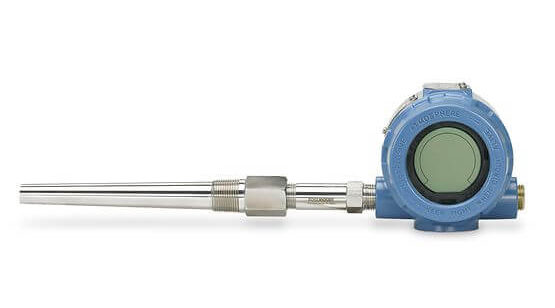
RTD Sensors
Temperature-Sensing Device to Measure Fluid Temperature
Industry-Leading Industrial Resistance Temperature Detectors (RTD) Sensors
RTDs are precision temperature-sensing devices used in conjunction with multivariable transmitters to improve the accuracy of differential pressure flow measurements. In these systems, the RTD monitors process temperature and sends that data to the transmitter, which then compensates for temperature and pressure variations to calculate and output a highly accurate flow signal.
RTD Sensor Key Benefits:
- Temperature Compensation & Accuracy: Provides real-time process temperature data for improved flow measurement accuracy when paired with a multivariable transmitter.
- Durability & Protection: Typically installed with a 316 stainless steel Thermowell to shield the sensor from process media, ensuring longevity and stability.
- Versatility: Suitable for a wide range of process fluids, including gases, steam, and liquids, under varying temperature and pressure conditions.
- Custom Configurations: Available in multiple materials (including 321 stainless steel and Alloy 600), custom insertion lengths, and mounting styles to suit specific line sizes and installation needs.
- Certified Performance: Hazardous location approvals and calibration certificates available for compliance and quality assurance.
By maintaining high accuracy and consistent performance across challenging environments, RTD sensors play a critical role in ensuring dependable flow measurement and process control.
Engineered for reliability and precision, RTD sensors are essential for maintaining consistent measurement performance in applications involving gases, steam, and liquids across a range of industrial environments.
RTD Sensor Specifications
RTD Sensor Materials
The RTD is made of various materials, but it is most commonly used with a thermowell to protect the sensor.
Typical material selections for standard applications:
- 316 Stainless Steel
Other options for material selection:
- 321 Stainless Steel
- Alloy 600
RTD Sensor Certifications
PFS is a contributor to various international standards committees, fully supporting our staff’s memberships to these commissions.
Individual products follow relevant industry regulations, including requirements specific to the oil and gas, water/wastewater, and power generation industries.
PFS maintains the following certifications, standards & compliances:
- ISO 9001
- AGA
- ASME S & U
- API
- ANSI
- European Pressure Equipment Directive (PED)
Applications

Oil & Gas
Across upstream production, midstream pipelines, and downstream refining, RTD sensors provide dependable temperature data for flow measurement, custody transfer, heater operations, and process control. Their compatibility with Thermowells ensures reliable performance in high-pressure and high-temperature environments.


Power Generation
Power plants rely on RTDs for monitoring steam temperatures, feedwater systems, turbine components, and cooling circuits. Their high accuracy under rapidly changing temperature conditions makes them essential for efficiency, safety, and equipment protection.

Chemical & Petrochemical
Processing RTD sensors are widely used to monitor process temperatures in reactors, heat exchangers, distillation systems, and storage tanks. Their stability and accuracy support precise temperature control in environments with corrosive media, thermal cycling, and strict process requirements.

Water & Wastewater Treatment
RTDs provide stable temperature readings for flow compensation, process control, and environmental monitoring. They perform reliably in treated water, aeration systems, filtration processes, and effluent monitoring applications.

Industry-Leading RTD Sensor Manufacturer Since 1983
Four Decades of Proven Expertise
For over 40 years, Primary Flow Signal has supplied high-accuracy flow measurement systems that rely on precise temperature inputs. Our RTD sensors are trusted across municipal, industrial, and process applications to deliver stable, repeatable temperature readings that support accurate differential pressure flow calculation
Custom-Engineered RTD Solutions & Support
Every process environment has unique temperature, pressure, and material requirements. PFS provides RTD sensors engineered to integrate seamlessly with multivariable transmitters, thermowells, primary flow elements, and complete flow measurement assemblies.
Our team offers application guidance, calibration options, and technical support to ensure your RTD is properly selected, installed, and performing to specification.
Certifications & Approvals
PFS RTD sensors are produced under ISO 9001 quality standards and can be supplied with hazardous-location approvals, material certifications, and calibration documentation to meet industry and project-specific requirements.