
HVT Operation in a Vacuum
PART ONE: The HVT Primary Element/Venturi Meter
The PFS-HVT (modified short form Venturi meter) is an ideal primary element when you are working with a vacuum pressure application. Below are some important considerations.
It is important to understand how the physics and installation differ from a standard positive-pressure application. The Venturi meter operates based on the principle that fluid flow is always from a higher absolute pressure to a lower absolute pressure, regardless of whether those pressures are above or below atmospheric pressure.
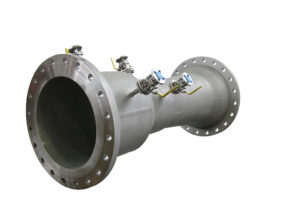
How the Venturi Works in a Vacuum
- The Venturi effect and vacuum: A Venturi works by creating a constriction (a “throat”) in a pipe. As a fluid (liquid or gas) passes through this constriction, its velocity increases, and its static pressure decreases, according to the Bernoulli principle.
- In a vacuum system, this pressure drop can push the fluid further into the sub-atmospheric range. It does not matter whether the starting pressure is positive or negative (vacuum)—the meter measures the differential pressure created by the flow.
- Vacuum generation, not just measurement: Specialized devices called Venturi vacuum generators (or vacuum pumps) use compressed air to create a vacuum. In these devices, the Venturi effect is the core mechanism used to generate the vacuum, not just measure it.
Installation Considerations in Vacuum Applications
Proper installation is critical to maintain accuracy, especially in vacuum applications where the pressure is already low.
- Orientation: The pressure taps should ideally be installed horizontally to reduce the risk of air pockets in liquids or condensation traps in gases, which can distort readings.
- Smooth Piping Runs: It is essential to have sufficient straight pipe lengths upstream and downstream of the Venturi to ensure a stable, uniform flow profile. This prevents turbulence that could interfere with the measurement.
- Isolation Valves and Drainage: For liquid systems, install drain or blow-off valves at any high or low points (“peaks and valleys”) in the impulse lines that connect the meter to the differential pressure transmitter. This prevents liquid or gas from becoming trapped and corrupting the reading.
Challenges in Vacuum Flow Measurement
Working with vacuum presents specific difficulties that must be accounted for to ensure accurate and stable readings:
- Boundary Layer Separation: At very low pressures, there is an increased risk of the fluid’s boundary layer separating from the pipe walls, creating turbulence. This can lead to unstable and inaccurate flow measurements.
- Cavitation Risk (Liquids Only): If you are working with a liquid and the vacuum pressure at the Venturi throat drops below the vapor pressure of the liquid, cavitation can occur. This is the formation of vapor bubbles that can damage the Venturi, cause noise, and drastically affect the accuracy of your readings.
- Maintaining Flow Stability: Because the pressure is low, any slight disturbance can cause significant variations. A stable flow is harder to achieve and maintain than in a positive-pressure system.
PART TWO: Secondary Instrumentation Options
In vacuum flow applications, accurate secondary instrumentation is critical. Because process pressures are below atmospheric, even small leaks or disturbances can distort readings. The following options provide reliable measurement strategies.
1. Sealed differential pressure (DP) transmitters:
Challenge: In vacuum conditions, the pressure within the pipe is below atmospheric pressure. This creates a risk of air and other non-process gases being drawn into the impulse lines that connect the Venturi to the transmitter.
Solution: Use a transmitter with remote diaphragm seals. This system uses a sealed, fluid-filled capillary tube to transfer the pressure from the process to the transmitter’s sensor, eliminating the risk of impulse line blockage and measurement drift caused by gas or condensation.
- Best for: Highly viscous or dirty fluids, and vacuum applications where contaminants could be sucked into traditional impulse lines.
- Enhanced Option: A multi-variable DP transmitter (such as the Rosemont model 3051SMV) is an ideal transmitter to use for vacuum gas flow applications because it processes line pressure and line temperature so it corrects for density changes and the output then becomes a mass flow output.
2. Absolute pressure sensors:
A standard Venturi setup can also be complemented with absolute pressure sensors to provide more comprehensive process data.
Function: Unlike gauge sensors that measure relative to atmosphere, absolute pressure sensors measure pressure relative to a perfect vacuum.
Usage in Venturi Systems: By placing two absolute pressure sensors—one at the Venturi inlet and one at the throat—you can measure the exact pressure drop regardless of atmospheric fluctuations. This is crucial for mass flow calculations of gases in a vacuum, as density is dependent on absolute pressure.
Calculation Support: A flow computer can use the two absolute pressure readings to perform a more accurate flow calculation, which is especially important for compressible fluids in a low-pressure environment.
Best Practice Setup for Vacuum Conditions:
The ideal secondary instrumentation setup for a Venturi in a vacuum often involves a combination of these technologies:
- DP transmitter with diaphragm seals: Use this to measure the core differential pressure across the Venturi, minimizing errors from impulse line issues.
- Absolute pressure sensor at the inlet: Place an absolute pressure sensor upstream of the Venturi to accurately measure the inlet pressure relative to a perfect vacuum. This provides the necessary data for calculating the fluid’s density.
- Flow computer: This device receives the signals from both the DP transmitter and the absolute pressure sensor to perform a precise mass flow calculation. For compressible fluids (gases), it can also incorporate temperature sensor data and a calculation for the fluid’s expansion or contraction to increase accuracy.
Consider using a multi-variable DP transmitter, which would eliminate the need for a pressure sensor, a temperature sensor and a flow computer. Including all of those functions in a single unit results in a very defendable and easily field-calibrated secondary instrument system.