
V-Cone Flow Meter Performance
A Review of Independent Test Data and Published Evaluations
By Bruce Briggs, President, Primary Flow Signal, Inc.
Executive Summary
The V-Cone is a differential-pressure (dP) flow meter that uses a cone-shaped element positioned within the flow stream to generate a measurable differential pressure. The design is commonly associated with reduced upstream and downstream straight-pipe requirements and improved tolerance of certain disturbed-flow conditions when compared with conventional orifice-plate installations.
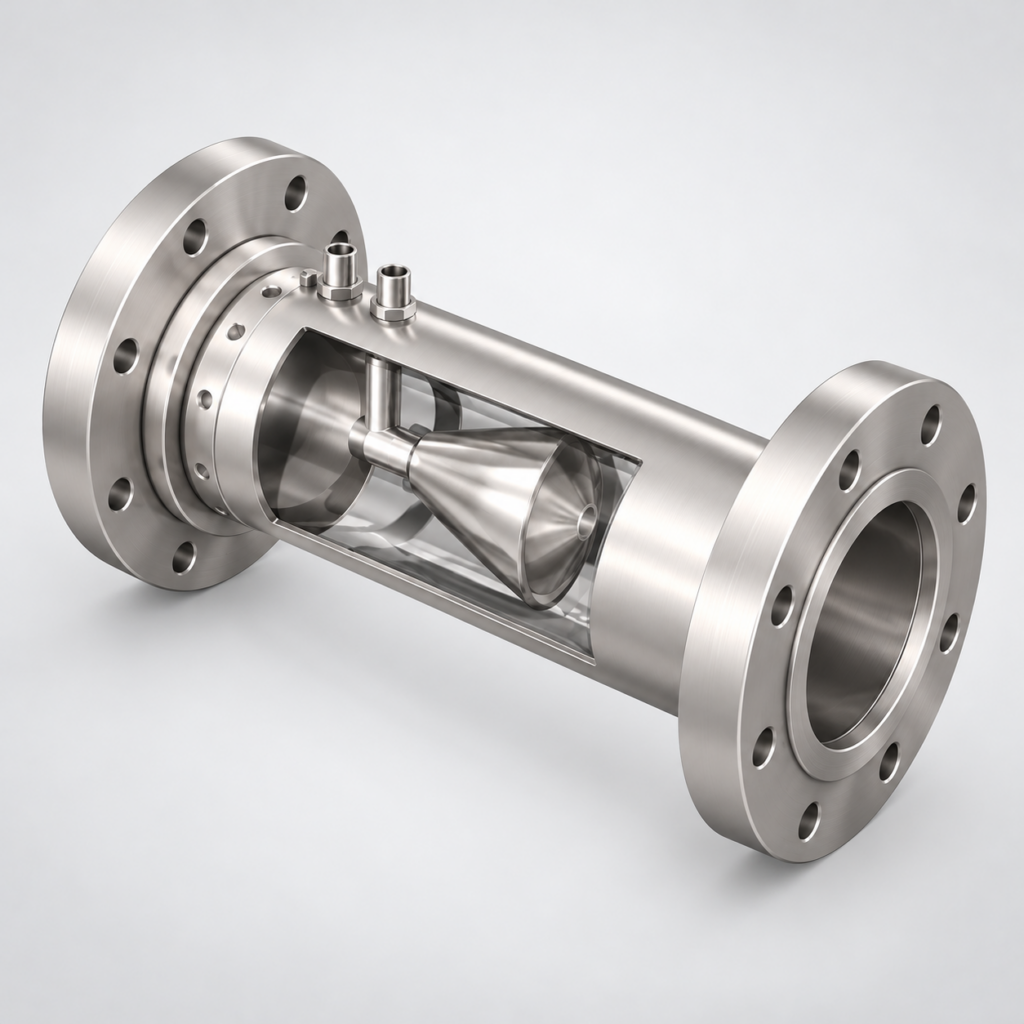
These characteristics can make the V-Cone a practical solution for applications where installation space or upstream flow disturbance is a significant consideration. However, meter selection should also account for permanent pressure loss, calibration performance, usable flow range, fluid characteristics, installation requirements, and long-term operating conditions.
This paper reviews published independent laboratory testing, academic research, calibration records, and manufacturer and industry literature addressing these performance characteristics. The available data indicate several considerations relevant to liquid-flow applications:
- Independent testing has reported permanent pressure loss for the V-Cone substantially higher than that of Venturi-type differential-pressure elements evaluated under comparable conditions.
- Measured discharge coefficients may differ from manufacturer-predicted values, reinforcing the importance of application-specific flow calibration where measurement accuracy is critical.
- Low-flow performance becomes increasingly dependent on Reynolds number and available differential-pressure signal.
- Fouling, scaling, pressure-tap condition, fluid properties, and installation configuration can affect measurement performance.
- Published long-term service experience exists for V-Cone installations, although independent quantitative data addressing long-term wear and dimensional change are comparatively limited.
These findings do not suggest that the V-Cone is unsuitable as a flow-measurement technology. Rather, they demonstrate the importance of evaluating the meter against the hydraulic and measurement requirements of the specific application instead of relying solely on generalized performance specifications.
Introduction
Differential-pressure flow measurement remains one of the most widely applied methods of industrial flow measurement. Although all DP primary elements operate by relating a measured pressure differential to flow rate, the geometry used to generate that differential can significantly influence permanent pressure loss, discharge coefficient, installation requirements, operating range, and sensitivity to process conditions.
The V-Cone differs from conventional orifice and Venturi designs by positioning a cone-shaped bluff body near the center of the pipe. Flow is directed around the cone, producing a differential pressure between the upstream pressure measurement and the low-pressure region associated with the cone.
Published literature attributes several advantages to this arrangement, particularly reduced straight-run requirements and tolerance of upstream swirl or disturbed velocity profiles. These characteristics have resulted in the use of V-Cone meters in oil and gas, chemical, water, and other industrial applications.
At the same time, independent testing and published calibration data provide useful information regarding performance characteristics that may not be apparent from nominal product specifications alone. The purpose of this paper is to review those data and identify engineering considerations relevant to the evaluation of V-Cone meters for liquid-flow measurement.
Permanent Pressure Loss
Permanent pressure loss is an important consideration in the selection of any differential-pressure primary element because unrecovered pressure represents energy that must be supplied elsewhere in the process.
Testing conducted by the Utah Water Research Laboratory at Utah State University evaluated several differential-producing flow-meter technologies, including a 12-inch V-Cone meter identified as McCrometer model VS12ND03N with a beta ratio of 0.596. For Reynolds numbers greater than 100,000, the study reported V-Cone permanent head loss equal to approximately 57.3% of the meter differential pressure.
Within the group of differential-pressure meters evaluated, the V-Cone and wedge meter exhibited the highest permanent head losses. The classical Venturi, Halmi modified short-form Venturi, and HBX Venturi evaluated in the same program exhibited lower head loss.
The observed difference is consistent with the respective geometries of the primary elements. A Venturi accelerates and subsequently decelerates the fluid through a contoured converging throat and pressure-recovery section. The V-Cone instead places an obstruction directly within the flow stream, producing flow separation and associated hydraulic losses.
Additional published academic work on cone-flow-meter hydraulics has reported overall pressure loss on the order of approximately 50% of generated differential pressure, generally consistent with the magnitude observed in the Utah State University testing.
Operating-Cost Implications
Permanent pressure loss can become economically significant in continuously operated pumping systems.
The Utah State University analysis included a 12-inch clean-water example operating at approximately 3,800 gpm. Using an electricity cost of $0.10/kWh and a 20-year service-life assumption, the study calculated approximately 131.7 inches of water head loss for the V-Cone and an associated pumping-energy cost of approximately $8,606 per year. When pumping cost was included, the study calculated an annualized cost of approximately $9,356 per year for the evaluated V-Cone installation.
The magnitude of this cost will vary substantially with flow rate, operating hours, system efficiency, energy price, meter geometry, and application. Nevertheless, the analysis demonstrates why permanent pressure loss should be evaluated as a lifecycle parameter rather than solely as a hydraulic specification.
For applications in which energy consumption or available system pressure is a primary design consideration, comparison of permanent pressure loss among candidate primary elements is therefore warranted.
Accuracy and Discharge-Coefficient Performance
Published V-Cone literature commonly identifies nominal accuracy of approximately ±0.5% of reading under specified conditions. Actual system performance, however, depends on several factors, including meter geometry, Reynolds number, transmitter performance, installation configuration, fluid properties, and calibration.
The Utah State University test program measured an average V-Cone discharge coefficient of approximately 0.8008 ±0.50% for Reynolds numbers greater than 100,000, compared with a manufacturer-predicted coefficient of 0.8143. This represents a difference of approximately 1.6% between the predicted and experimentally determined discharge coefficients.
The study further reported that, at Reynolds numbers at and above approximately 8,000, the measured coefficient did not consistently remain within the manufacturer’s stated ±0.50% range relative to the predicted value.
This distinction is important. A meter may exhibit good repeatability while still having an actual discharge coefficient that differs from a generalized or predicted coefficient. Where measurement uncertainty is critical, calibration of the specific meter and configuration can therefore provide substantially greater confidence than reliance on a nominal coefficient alone.
Field Calibration Results
Calibration records associated with a United Nations Framework Convention on Climate Change Clean Development Mechanism project provide an additional field example.
Five V-Cone meters identified as having manufacturer-specified accuracy of ±0.5% produced calibrated accuracy values ranging from approximately ±0.78% to ±0.97%. The project subsequently applied a conservative ±1% value to the monitored flow data.
These results do not establish that all V-Cone meters will perform outside published accuracy specifications. They do demonstrate, however, that actual calibrated performance can differ from nominal specifications and that meter-specific calibration is appropriate where uncertainty has contractual, regulatory, process-control, or financial significance.
Influence of Fluid Properties
Differential-pressure measurement depends upon the relationship between pressure differential, fluid density, primary-element geometry, and discharge coefficient. Changes in process-fluid properties can therefore introduce measurement error when the assumptions used in the flow calculation no longer represent actual operating conditions.
Published V-Cone literature and case histories indicate sensitivity to fluid composition and property assumptions. One documented case cited in the source literature reported flow-rate errors reaching as high as 18% when changes in fluid composition were not properly accounted for.
This should not be interpreted as an inherent 18% accuracy limitation of V-Cone technology. Rather, it illustrates the potential magnitude of error when process conditions differ materially from those used to establish the meter calculation.
Accurate density, composition, pressure, temperature, and other required compensation inputs remain important for DP flow measurement generally, particularly where process conditions vary significantly.
Turndown and Low-Flow Performance
Published turndown ratios for V-Cone meters vary considerably. Depending upon the source, reported values range from approximately 5:1 to 10:1 for certain configurations and substantially higher under other stated conditions.
Independent testing helps illustrate why a single turndown value may not adequately describe actual meter performance. In the Utah State University testing, the V-Cone discharge coefficient remained within the evaluated accuracy range over approximately a 10:1 Reynolds-number range of 50,000 to 500,000. Variability increased below that range, and the coefficient decreased significantly below a Reynolds number of approximately 10,000.
Low-flow performance is also constrained by the basic characteristics of differential-pressure measurement. As flow decreases, generated differential pressure decreases rapidly, reducing the available measurement signal and increasing the relative significance of transmitter uncertainty, noise, zero stability, and other system effects.
Accordingly, the practical lower limit of a V-Cone installation should be evaluated using the expected operating Reynolds-number range and complete measurement system rather than a generalized maximum turndown ratio. Applications with large seasonal or process-driven variations in flow may warrant particular attention to this issue.
Fouling, Scaling, and Pressure-Sensing Considerations
The annular flow path of the V-Cone is frequently described as resistant to fouling or as having self-cleaning characteristics. Published technical literature also identifies circumstances in which deposits, sediment, fibrous material, scaling, or crystallization may affect meter performance.
Accumulation on the cone or surrounding flow surfaces can alter the effective geometry of the primary element. Because the discharge coefficient is related to that geometry, sufficient accumulation can result in measurement drift.
The susceptibility of a particular installation will depend strongly on the process fluid. Clean-water service, for example, presents substantially different conditions from fluids containing suspended solids, fibers, precipitates, crystallizing compounds, or other contaminants.
Pressure-sensing systems require similar consideration. Plugging or leakage of pressure taps and impulse lines can affect the differential-pressure signal and increase maintenance requirements in contaminated service.
For liquid installations, trapped gas within pressure-sensing lines can also cause signal instability. Appropriate installation practice therefore includes proper orientation and pitching of impulse lines and removal of entrained air during commissioning.
Claims of fouling resistance should consequently be considered application-dependent rather than universal. Fluid composition, solids loading, scaling potential, orientation, pressure-tap arrangement, and maintenance practices should all be considered during meter selection.
Wear, Erosion, and Corrosion
The V-Cone element is positioned directly within the flowing fluid and is therefore exposed to the process environment throughout operation.
Published technical literature identifies erosion and corrosion of the cone as potential concerns in highly abrasive or corrosive service. Dimensional change of the cone or associated pressure-tap geometry can affect the meter coefficient and, consequently, measurement accuracy.
Manufacturer-sponsored literature presents favorable long-term operating experience in certain abrasive and particle-laden applications and reports extended service periods with limited maintenance. Such case histories provide useful evidence that V-Cone meters can perform successfully under demanding operating conditions when appropriately selected and applied.
Independent quantitative information addressing long-term dimensional change, however, is more limited. The Utah State University comparison noted that field measurements of V-Cone wear, erosion, corrosion, and before-and-after measurements of aged meter geometry were not available within the data reviewed for that study. The researchers therefore could not independently quantify the long-term effect of these mechanisms on measurement performance.
This distinction is important. Published service history supports the potential for long operating life, but the available independent literature reviewed here does not provide sufficient quantitative data to establish a universal long-term wear rate or recalibration interval.
For abrasive or corrosive applications, material selection, inspection requirements, expected service conditions, and calibration strategy should therefore be considered individually.
Manufacturing Geometry and Pressure-Tap Configuration
The performance of a differential-pressure primary element is closely related to its physical geometry and pressure-measurement locations.
Utah State University researchers identified V-Cone geometry and pressure-tap placement as potential contributors to differences between measured discharge coefficients and coefficients reported in other published data. The researchers specifically noted that pressure-tap orientation is not identical across all V-Cone meter configurations.
Published technical material also recognizes the machining tolerances required for the cone and associated pressure-tap features, particularly for smaller meter sizes.
These factors reinforce the importance of distinguishing between performance demonstrated by a particular calibrated meter and generalized performance attributed to the technology as a whole. Where high measurement accuracy is required, meter-specific calibration provides a direct means of accounting for dimensional and pressure-tap variations present in the completed assembly.
Installation Considerations for Liquid Service
One of the recognized advantages of the V-Cone is its ability to operate with shorter straight-pipe requirements than many conventional DP-meter installations. This can be valuable where piping layout is constrained or where disturbances are located relatively close to the meter.
Reduced straight-run requirements, however, should not be interpreted as complete independence from installation effects. Elbows, valves, reducers, and other upstream fittings can alter the velocity profile and swirl characteristics entering the meter. Depending on the severity and location of the disturbance, additional straight run or flow conditioning may still be appropriate.
Liquid installations also require consideration of the differential-pressure measurement system. Pressure connections and impulse lines should be configured to minimize trapped gas and should be properly commissioned before operation.
A separate DP transmitter is normally required to convert the primary-element differential into a usable measurement signal. The transmitter introduces its own uncertainty, calibration requirements, maintenance interval, and service life, all of which should be considered when evaluating overall system performance. The primary element and transmitter should therefore be evaluated as a complete measurement system rather than as independent components.
Comparative Permanent-Pressure-Loss Performance
The Utah State University laboratory study provides a useful direct comparison of permanent head loss among several differential-producing meter designs.
| Meter Type | Relative Head-Loss Result in Independent Testing |
|---|---|
| V-Cone | Among the highest head losses of the DP meters evaluated |
| Wedge Meter | Among the highest head losses of the DP meters evaluated |
| Classical Venturi | Lower than V-Cone |
| Halmi Modified Short-Form Venturi | Lower than V-Cone |
| HBX Venturi | Lower than V-Cone |
Source: Utah State University, Comparison of Selected Differential-Producing, Ultrasonic, and Magnetic Flow Meters.
These results are specific to the meters and test conditions evaluated and should not be interpreted as establishing a universal pressure-loss value for every meter size, beta ratio, or application. They do, however, demonstrate a meaningful difference in hydraulic performance between the V-Cone and the Venturi-type elements included in the study.
Engineering Considerations for Meter Selection
The published data reviewed in this paper indicate that the V-Cone has legitimate application advantages. Its tolerance of certain disturbed-flow conditions and comparatively short straight-run requirements can be particularly valuable where piping configuration limits the use of other technologies.
Meter selection, however, requires evaluation of more than installation length. For applications in which permanent pressure loss, low-flow accuracy, lifecycle energy consumption, or long-term measurement stability are important, the following factors should be evaluated:
- Expected operating flow and Reynolds-number range
- Permanent pressure loss at normal and maximum flow
- Available system pressure and associated pumping-energy cost
- Required measurement uncertainty
- Availability of meter-specific flow calibration
- Fluid density and composition variability
- Solids, scaling, crystallization, erosion, and corrosion potential
- Pressure-tap and impulse-line maintenance requirements
- Upstream piping configuration and flow disturbances
- Transmitter rangeability, uncertainty, and calibration requirements
- Expected service life and inspection requirements
No single flow-meter technology is optimal for every application. The appropriate primary element is the one whose documented hydraulic and measurement characteristics best satisfy the requirements of the specific process.
Conclusion
The V-Cone is an established differential-pressure flow-measurement technology with demonstrated advantages in applications involving limited straight-pipe availability and certain disturbed-flow conditions. Independent laboratory testing and published calibration data also identify performance characteristics that should be considered during meter selection.
Most notably, the independent data reviewed for this paper indicate that the V-Cone can produce substantially greater permanent pressure loss than Venturi-type primary elements evaluated under comparable conditions. Published testing also demonstrates that actual discharge coefficients can differ from predicted values and that low-flow performance becomes increasingly sensitive to Reynolds number and available differential-pressure signal.
Additional considerations include fluid-property variation, fouling and scaling potential, condition of pressure-sensing components, installation configuration, and possible dimensional changes associated with long-term erosive or corrosive service.
These observations do not establish that the V-Cone is unsuitable for liquid-flow measurement. They demonstrate that its suitability should be determined on an application-specific basis. Where measurement accuracy, permanent pressure loss, lifecycle energy consumption, or long-term stability are critical design criteria, selection should be supported by applicable independent performance data and, where appropriate, calibration of the completed meter assembly.
A technically sound comparison should therefore consider not only initial installation requirements, but the complete hydraulic, measurement, maintenance, and lifecycle performance of the flow-measurement system.
Looking for Additional Guidance for Your V-Cone Flow Meter?
References
- ASGMT. An Overview of the McCrometer V-Cone Meter Performance.
- Utah State University / Utah Water Research Laboratory. Comparison of Selected Differential-Producing, Ultrasonic, and Magnetic Flow Meters.
- IMEKO TC9. Flomeko 2019 Proceedings.
- Sino-Inst. An Overview of V-Cone Flow Meters.
- Unithai. V-Cone Flow Meter Technical Brief.
- McCrometer. V-Cone Differential Pressure Flow Meter IOM Manual.
- United Nations Framework Convention on Climate Change — Clean Development Mechanism. Application of Calibration Results to Correct for Lower Accuracy.
- IOSR Journal. Design of V-Cone Meter to Measure Water Flow.
- McCrometer. A Review of the V-Cone Meter for Natural Gas Flows.
- Springer. Review of Metering and Gas Measurements in High-Volume Shale Gas Wells.
- McCrometer. V-Cone Differential-Pressure Meters: Accuracy To Go With The Flow.
- Tundra Process Solutions / McCrometer. V-Cone case study.
- McCrometer. Long Term Performance of V-Cone Flow Meters.
Author Bio
Bruce Briggs is the President, and Principal of Primary Flow Signal, Inc., a global manufacturing, engineering, and technology resource focusing on highly accurate, repeatable and reliable differential flow meters.