
Modified Short-Form Venturi Meters for Geothermal Steam Flow Applications
By Bruce Briggs, President, Primary Flow Signal, Inc.
Why Steam Flow Measurement Is Central to Geothermal Operations
Every geothermal power plant runs on an accounting problem as much as a thermodynamic one: production from multiple wells has to be metered, allocated, and reconciled against what actually reaches the turbine, for everything from royalty payments and reservoir management to turbine performance testing and plant efficiency tracking.
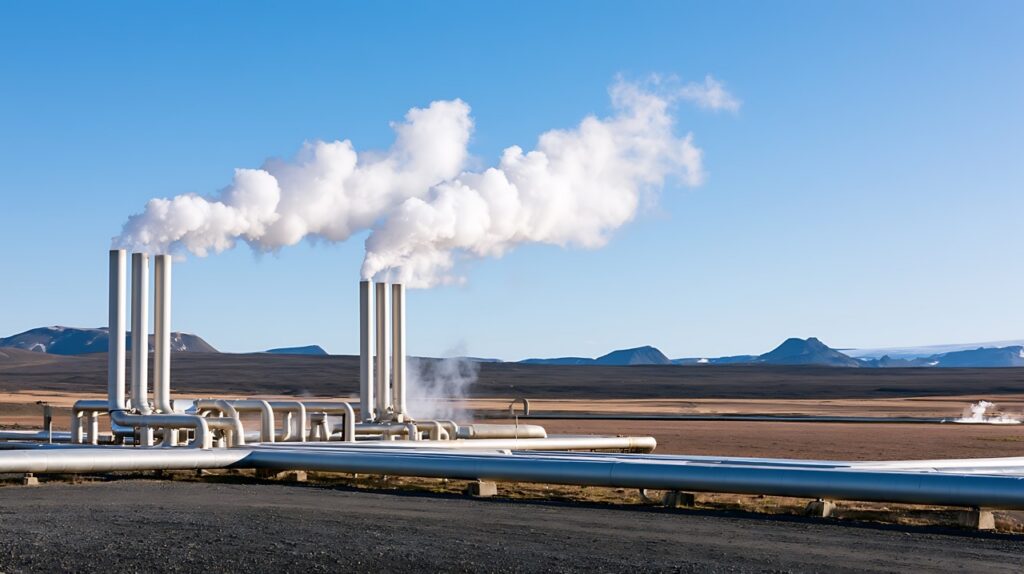
Differential-pressure meters have long been the workhorse technology for this job. As the SPE PetroWiki summary of geothermal production measurement puts it, “differential producer-type flowmeters, such as orifice, Venturi and pitot tubes, are often used for steam, water and gas-flow rate measurement” in geothermal fields.
At The Geysers geothermal field in California — one of the largest and longest-operating geothermal complexes in the world — field engineers have historically used orifice plates and pitot tubes for well-testing measurements, “whereas Venturis are generally used to measure steam flow into a power plant” (GRC/Geo-Energy publication on Geysers measurement practice).
That division of labor is not incidental — it reflects the Venturi’s particular strengths for continuous, high-value steam metering: no moving parts, low permanent pressure loss (preserving usable steam energy for the turbine), and long-term reliability in a punishing thermal and chemical environment.
What Makes Geothermal Steam Measurement Difficult
Geothermal steam is a much harder fluid to meter accurately than clean, dry industrial steam, for several compounding reasons:
1. Silica scaling:
Geothermal fluids typically carry dissolved silica at concentrations well above what surface pressures and temperatures can hold in solution. As steam flashes off and the remaining fluid cools and depressurizes, dissolved silica becomes supersaturated and precipitates as amorphous silica scale on pipe walls, restrictions, and any small sensing ports it can reach — a well-documented operational problem across geothermal fields worldwide (MDPI — Overview of Silica Scaling Reduction Technologies; ScienceDirect — Silica scaling in geothermal heat exchangers).
Scale buildup narrows flow paths, increases back pressure, and — critically for metering — can plug the small-bore pressure-sensing passages that differential-pressure meters depend on. PFS offers a special electro-polished interior profile to eliminate the typical build-up.
2. Wet, two-phase steam:
Much of the fluid arriving at a geothermal wellhead is a two-phase mixture of steam and brine, and even after separation the “dry” steam leg often still carries some liquid carryover. Metering wet steam accurately requires either a genuinely dry-steam measurement point or a correction methodology — such as a Pressure Loss Ratio (PLR) or Lockhart-Martinelli-based quality correction — to account for liquid loading in the differential-pressure signal (NFOGM — Saturated Wet Steam Orifice Meter Tests at a Geothermal Power Station).
3. Corrosive, erosive chemistry:
Geothermal steam commonly carries non-condensable gases (CO₂, H₂S) and chloride species, which drive corrosion, while entrained silica and mineral particulate contribute to erosive wear on flow-restricting elements over time.
4. High temperature and pressure:
Saturated or superheated geothermal steam service routinely runs at temperatures and pressures well above typical process steam, demanding metering hardware rated for sustained thermal cycling as wells are brought online, tested, and taken offline.
5. Wide, declining flow ranges:
Individual well output typically declines over the field’s productive life, and multiple wells are often combined into shared gathering headers, so a meter installed at field startup needs to stay accurate across a much wider flow range than its original design point.
6. Remote, space-constrained wellhead and steam-field piping:
Wellhead and gathering-line piping is rarely laid out with generous straight runs reserved for future metering, particularly at brownfield sites being retrofitted with better instrumentation.
Where Classical Designs Run Into Trouble
The classical, code-defined Venturi tube (per ASME MFC-3M / ISO 5167) is a proven choice for clean, high-pressure, high-temperature steam and liquid service in general industrial settings, and Primary Flow Signal’s own Classical Venturi (CV) line is explicitly built for that role, “widely used for high pressure and
high temperature steam flow and liquid flow” (Primary Flow Signal — PFS-CV ASME Fabricated Type Venturi Meter datasheet).
But its traditional annular pressure-averaging chamber is a real liability once silica scaling enters the picture: several major flow-metering suppliers now build dedicated geothermal steam systems around heated annular chambers specifically to keep silica and condensate from plugging the sensing ports in a classical-style Venturi geometry — a workaround that adds cost, complexity, and another system (heat tracing) that has to keep working reliably at a remote wellhead (KROHNE Geothermal Steam Measurement Systems).
The classical geometry’s long overall length and straight-pipe requirements also work against retrofit installations in already-congested steam-field piping.
The Modified Short-Form Venturi Advantage in Steam Service
The modified short-form Venturi — the Halmi-type design commercialized as the HVT — was engineered from the outset around exactly the kind of “harsh or contaminated line fluids” that geothermal steam represents.
The HVT-Halmi Venturi Flow Element delivers “the highest accuracy and reliability for flow measurement of pressurized line fluids, including liquids, gasses, and steam, as well as high-viscosity line fluids, solids-bearing line fluids, and harsh or contaminated line fluids,” and notes specifically that “the adiabatic expansion factor is known and applicable so flow measurement of gas and steam line fluids is fully supported” (Environmental Expert — HVT-Halmi Venturi Primary Flow Element).
Several design characteristics translate directly into geothermal steam benefits:
- Single high- and low-pressure taps instead of an annular chamber. With no ring of small piezometer holes to feed a common chamber, there is far less surface area and passage length for silica scale to accumulate and block — the same self-scouring principle that makes this design attractive for sediment-laden and solids-bearing fluids elsewhere in the line (PFS — HVT Compact Venturi datasheet). Where a classical annular-chamber design in geothermal service typically needs added heat tracing to stay clear of scale (KROHNE), the modified short-form design’s simpler, cleanable tap geometry reduces that dependency.
- All-metal, high-temperature/pressure-rated construction. Fabricated HVT-type elements are built as all-metal primary flow elements suited to pressurized, high-temperature line fluids, matching the demands of geothermal steam headers (available with the optional full electro-polished interior profile to eliminate build-up) (Water Online — HVT-FV product listing).
- Rock solid and stable discharge coefficient across a wide flow range. Based on prior independent laboratory flow calibrations, published performance for the fabricated HVT-type element runs ±0.50% of rate uncalibrated, improving to ±0.25% with laboratory calibration (Water Online — HVT-FV product listing). That stability over a wide Reynolds-number range is exactly what is needed as well output declines over a field’s productive life and as gathering headers combine flows from wells at very different production stages.
- A short, retrofit-friendly footprint. The same shortened flange-to-flange body, truncated recovery cone, and flexible mounting orientation that make the modified short-form Venturi attractive for tight municipal and industrial retrofits apply equally well to congested wellhead and steam-field piping, where a classical Venturi’s long straight-run requirements are often simply unworkable (PFS — HVT Compact Venturi datasheet).
- Low permanent pressure loss. In a geothermal plant, every unit of steam pressure lost to a metering run is pressure the turbine no longer sees. The modified short-form design’s steeper, truncated recovery cone and shorter throat give it materially lower unrecovered head loss than a classical Venturi of the same beta ratio — a direct efficiency benefit in continuous steam service.
Handling Wet Steam and Two-Phase Flow
Not every metering point in a geothermal facility sees clean, dry steam. Differential-pressure devices — including Venturis — have a long track record being adapted for wet, saturated steam service through wet-steam correction methods.
Research into critical-flow Venturi nozzles with saturated wet steam found that, once calibrated, agreement with a condensate weigh-tank reference could be held to within about 2%, with roughly half of that uncertainty attributable to the calibration rig itself rather than the meter (ScienceDirect — The use of critical flow Venturi nozzles with saturated wet steam); the same body of work notes that pairing the meter with an efficient upstream steam/water separator, so the fluid can be treated as dry saturated steam, is often the more practical route to a defensible uncertainty figure.
More recent geothermal-specific research has extended this further, developing real-time methods to compute both mass flow rate and fluid enthalpy directly from differential-pressure devices — orifice plates, Venturi tubes, and nozzles — installed on large-diameter (8-to-20-inch-plus) two-phase geothermal gathering lines in Indonesian and New Zealand fields (field application referencing Mubarok et al. 2019 and Zarrouk et al. 2019), and a mass-balance evaluation of steam and brine flow metering at the Sorik Marapi geothermal plant in Indonesia found metered steam mass flow within roughly 11% of the generator-output cross-check, illustrating both the practical value and the real-world uncertainty bands operators work with on two-phase lines (Universitas Islam Riau repository — Sorik Marapi flow measurement evaluation).
For a modified short-form Venturi specifically, the same underlying principle applies: the closer the metering point is to genuinely dry, separated steam, the closer actual field performance will track the meter’s calibrated dry-gas/steam accuracy; installations on two-phase or wet-steam legs should budget for an added quality-correction uncertainty on top of the base meter specification.
Where It Fits in a Geothermal Steam System
- Post-separator dry steam headers feeding the turbine — the highest-value, most continuous metering point in the plant, and the application closest to the modified short-form Venturi’s core calibrated performance envelope, consistent with the historical practice of using Venturis for steam flow into the power plant at large geothermal complexes such as The Geysers (GRC/Geo-Energy Geysers measurement publication).
- Individual well and gathering-header production metering — where the compact, retrofit-friendly footprint and wide calibrated flow range help absorb the natural production decline of individual wells over the reservoir’s life.
- Turbine acceptance and performance testing — geothermal plants running formal turbine performance tests under codes such as ASME PTC-6 rely on high-precision primary flow elements; Primary Flow Signal’s own PTC-6 ASME flow nozzle product line reflects the broader family of differential-pressure primary elements — including its modified short-form Venturis — engineered for this level of precision in steam-turbine testing work.
Reliability and Maintenance Payoff
The operational case for the modified short-form Venturi in geothermal steam service ultimately comes down to uptime and trust in the data. A meter whose pressure taps gradually silt up with amorphous silica does not fail cleanly — it drifts, quietly biasing production and allocation figures until someone notices a discrepancy against turbine load or a well test.
The self-scouring, single-tap geometry, cleanout access, and all-metal high-temperature construction of the modified short-form design are specifically aimed at avoiding that slow drift, keeping the metered number trustworthy between the periodic well tests and reconciliations that geothermal operators depend on to run the field and settle accounts.
Conclusion
Geothermal steam is one of the more demanding fluids a differential-pressure meter will ever see: hot, often wet, laden with dissolved silica that turns into scale the moment conditions change, and delivered through wellhead and gathering piping that was rarely laid out with generous straight runs for instrumentation.
The modified short-form Venturi’s core design advantages — a self-scouring single-tap pressure-sensing geometry instead of a scale-prone annular chamber, a compact retrofit-friendly footprint, all-metal high-temperature construction, low permanent pressure loss, and an individually calibrated discharge coefficient that stays stable across a wide flow range — map directly onto those challenges.
For geothermal operators looking to meter steam accurately, repeatably, and reliably over the multi-decade life of a producing field, it offers a purpose-built alternative to retrofitting a classical Venturi with supplemental heat tracing just to keep its sensing ports clear.