
Modified Short-Form Venturi Meters for Accurate, Repeatable, and Reliable Irrigation Flow Measurement
Why Irrigation Flow Measurement Matters More Than Ever
By Bruce Briggs, President, Primary Flow Signal, Inc.
Irrigation districts, municipal water utilities, and individual growers are all under growing pressure to measure delivered water with real precision. Flow data underpins water-rights accounting, inter-district billing, drought allocation, and regulatory reporting, and the bar keeps rising.
ISO 16399:2023, Agricultural irrigation equipment: Meters for irrigation water, sets maximum permissible errors as tight as ±1% in the upper flow-rate zone for certified irrigation meters, and international legal-metrology standards such as OIML R49-1 require documented repeatability (the standard deviation of three measurements at the same flow rate) to be no more than one-third of the allowed error. State water boards and departments of water resources back this up with their own minimum standards for measuring devices used to document water use (Idaho Department of Water Resources).
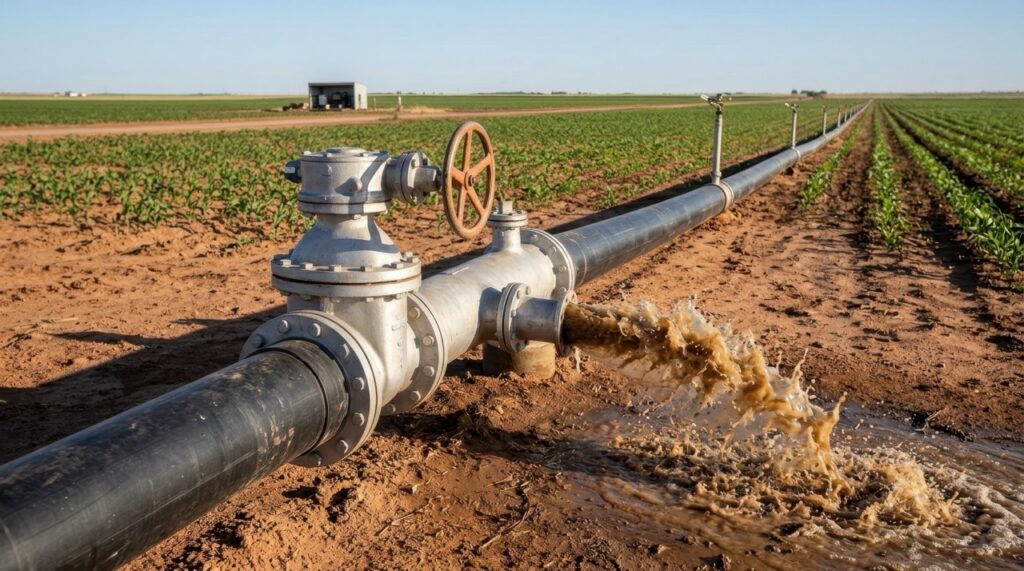
The U.S. Bureau of Reclamation’s own Water Measurement Manual is blunt about the stakes and the tradeoffs: differential-head meters like the Venturi are “one of the most accurate type[s] of flow measuring device that can be used in a water supply system,” with a potential accuracy of ±0.25%, no moving parts, and very low maintenance, but the manual also cautions that “the usual maintenance and pipe conditions that generally occur in irrigation pipe systems limit field accuracies to within 3 to 5 percent of actual” for typical differential-pressure meters (USBR Water Measurement Manual, Ch. 14).
That gap between laboratory-grade accuracy and what actually survives years in an irrigation pipeline is exactly the problem the modified short-form Venturi design was built to close.
The Field Realities of Irrigation Flow Measurement
Irrigation systems put a distinctive set of stresses on a flow meter that most industrial or municipal applications don’t:
- Sediment- and debris-laden water. Canal water, well water, and reused agricultural drainage frequently carry silt, sand, algae, and organic debris that can plug pressure-sensing ports and manometer lines over time (USBR Water Measurement Manual, Ch. 14).
- Wide seasonal turndown. A single delivery point may need to measure accurately from a near-trickle winter maintenance flow up to peak irrigation-season demand, a much wider range than many treatment-plant or process applications see.
- Low and variable available head. Canal-fed or gravity-fed systems often have very little pressure to spare; every inch of unrecovered head loss through a meter is water-delivery capacity or pumping energy lost.
- Remote, unpowered, or minimally staffed sites. Farm turnouts, canal headgates, and lateral delivery structures are frequently far from power and telemetry, favoring devices that work reliably without active control power. With the high quality and high performance of smart, solar or battery powered secondary instruments, no available power issues are easily overcome.
- Tight retrofit space. Much of the country’s irrigation infrastructure predates modern metering codes, so a replacement meter often has to fit into an existing vault, valve box, or short pipe run without re-engineering the whole structure.
- Long service life expectations. Irrigation infrastructure is typically expected to run for decades between major capital upgrades, so wear-prone components are a long-term liability.
A meter that is accurate on day one but degrades with sediment fouling, or that is accurate but requires 15–20 pipe diameters of straight upstream run that no farm turnout has room for, does not actually solve the measurement problem in the field.
Why the Classical Venturi Struggles With These Constraints
The classical, code-defined Venturi tube (ASME MFC-3M / ISO 5167) earns its fixed discharge coefficient by adhering to a long, prescriptive geometry: roughly a 21° entrance cone, a throat one full diameter long, and a shallow 5°–15° recovery cone that expands all the way back to the pipe’s full diameter. Its upstream and throat pressures are typically sensed through an annular chamber that averages several small piezometer holes around the pipe circumference.
In an irrigation setting, that geometry cuts against several of the field realities above: the long body doesn’t fit many retrofit vaults, the annular chamber’s small ports are more prone to silt and debris plugging, and the discharge coefficient is only guaranteed constant down to a pipe Reynolds number of roughly 200,000, well above the low-flow end of a typical irrigation turndown range (Dwyer/Omega).
It is telling that the Bureau of Reclamation itself notes that “the expense of Venturi meters and the fact that they must always operate with full pipelines have restricted their use on a broad scale in irrigation systems” historically, even while acknowledging their inherent accuracy advantage (USBR Water Measurement Manual, Ch. 14).
The Modified Short-Form Venturi: Purpose-Built for the Field
The modified short-form Venturi, the design lineage pioneered by Dezső Halmi and commercialized in meters such as Primary Flow Signal’s HVT, keeps the fundamental Venturi principle (a smooth, gradual constriction with differential-pressure sensing and a recovery cone) but re-engineers the geometry around real installation constraints rather than a fixed code shape:
- Shortened body. The throat is roughly half the length of a classical throat, the entrance and recovery angles are steeper, and the recovery cone is truncated rather than re-expanding all the way to the downstream pipe size, cutting the overall flange-to-flange length dramatically and letting the meter fit into “challenging piping layouts and difficult installation requirements” (PFS HVT Compact Venturi datasheet).
- Single high- and low-pressure taps in place of an annular chamber, located in the cylindrical entrance section at the same diameter as the inlet piping, a design that “eliminates sediment accumulation, reducing maintenance,” and is fitted with manual tap cleanout rods for quick clearing if debris does collect (PFS HVT Compact Venturi datasheet).
- Installation flexibility. These meters can be installed vertically (up or down), horizontally, or at any intermediate angle, which matters enormously when retrofitting existing irrigation pipe runs that were never designed around a metering spool (PFS HVT Compact Venturi datasheet).
- Rugged, field-appropriate materials. Available in cast iron and ductile iron construction in addition to fabricated metal and (as well as a wide range of synthetic materials such as PVC, Kynar, etc) some ideal for direct buried installations (PFS HVT-CI/HVT-DI).
Accuracy and Repeatability Where It Counts: In the Field, Over Time
As the Bureau of Reclamation’s own irrigation-operator training material states plainly, “(Classical) Venturi meters must be calibrated” when high and reliable accuracy is required and calibrated units are “usually accurate to within 2 percent” (USBR HYD-577, Water Measurement Procedures). That two-percent figure is a reasonable benchmark for ASME, ISA classical Venturi designs.
A factory-engineered modified short-form Venturi meter starts from a materially better baseline. Because the HVT has a prior calibration determined discharge coefficient which is independent of line size or beta ratio (beta ratio is the ratio of the throat size (d) and the line size (D) d/D) which results in the published performance for the HVT-type Compact Venturi being ±0.5% of actual flow rate as installed, improving to ±0.25% with laboratory calibration, with a constant discharge coefficient that holds across a wide, stable flow range rather than degrading at low flow (PFS HVT Compact Venturi datasheet).
That performance is consistent with the broader class of short-form/universal Venturi designs, which independent references credit with discharge-coefficient uncertainty of about 0.5% down to a pipe Reynolds number of roughly 75,000 (versus 0.7%–1.5% for a classical Venturi above Rd 200,000) and system accuracies of 0.25%–1.2% across published liquid and gas flow tests (Dwyer/Omega).
Repeatability matters as much as absolute accuracy for irrigation accounting, since water deliveries are typically billed or allocated against repeated readings over a season, not a single lab test. OIML R49-1 formalizes this by requiring that the standard deviation across repeated measurements at a given flow rate stay within one-third of the meter’s maximum permissible error (OIML R49-1:2024).
The modified short-form Venturi’s stable, self-conditioning flow profile and its resistance to the port-fouling drift that erodes accuracy in annular-chamber designs both work directly toward that kind of long-term repeatability, not just a one-time calibration number.
For comparison, Utah State University Extension’s guidance to irrigation system operators recommends selecting a flow meter with “no greater than ±2% flow error” and notes that a Venturi “can be quite accurate” with “no moving parts,” while flagging that its performance “relies on accurate pressure measurements,” a design constraint the single-tap, sediment-resistant HVT geometry directly addresses (Utah State University Extension). The same guidance highlights that competing technologies commonly used in irrigation, paddle-wheel meters (±3%–10%) and propeller/turbine meters (±2% and subject to mechanical wear), carry either wider tolerance bands, moving-part maintenance burdens, or both.
Reliability: No Moving Parts, Self-Scouring Geometry, Long Service Life
Reliability in irrigation service is less about a spec sheet and more about what still works correctly after years of sediment, seasonal shutdowns, and minimal maintenance attention. Three characteristics of the modified short-form Venturi work directly in its favor:
- No moving parts. Unlike propeller, turbine, or paddle-wheel meters, there is nothing inside the flow stream to wear, bind, or foul with vegetation and debris, a decades-old advantage of differential-head meters generally (USBR Water Measurement Manual, Ch. 14).
- Self-scouring hydraulics. Historical field experience with Venturi-type meters used specifically for sediment-bearing irrigation water backs this up directly: a New Mexico Water Resources Research Institute study on Venturi-type measurement in irrigation ditches concluded the device was “accurate enough for all irrigation purposes, and since it remains clear of sediment, the reliability of its measurement is believed to be greater than that of other methods” (NM WRRI Bulletin 423). The modern HVT-type design extends that same principle with a flow-conditioning profile and cleanout-accessible single taps rather than a chamber that must be flushed.
- Long, documented service life. Primary Flow Signal cites a field example of a shortened HVT-based Rate of Flow Controller replacing a 1950s-vintage direct-acting unit after 60 years of continuous service, not because the Venturi element failed, but because plant upgrades increased the required flow rate beyond the original unit’s capacity, with current HVT-ROFC systems backed by a 20-year warranty on the Venturi element itself (PFS HVT Compact Venturi datasheet).
Beyond Measurement: Pairing the Venturi With Automatic Flow Control
One of the most valuable applications of the modified short-form Venturi in irrigation is not passive measurement alone but active, self-contained rate-of-flow control.
A Rate of Flow Controller (ROFC) couples the Venturi’s differential-pressure signal directly to a modulating control valve, commonly an AWWA C504-compliant butterfly valve, so that the system automatically holds a set delivery rate as upstream canal levels, pump output, or downstream demand fluctuate (The “automatic” version of this ROFC requires power for the modulating electric valve actuator but fixed position control can be easily achieved without any power requirements) (PFS HVT Compact Venturi datasheet).
For an irrigation district, this is the difference between simply knowing how much water passed a turnout and actually delivering the intended, contracted flow rate consistently to every farm connection regardless of what is happening elsewhere in the canal system, a meaningful tool for water-delivery equity, drought-year allocation enforcement, and reducing over-delivery waste. Because the HVT’s discharge coefficient is stable across a wide flow range, the ROFC can maintain accurate control down into lower-demand shoulder-season flows, not just at peak summer demand.
Installation Advantages for Retrofit and New Irrigation Infrastructure
The shortened flange-to-flange length of the modified short-form Venturi is not just a cost or shipping benefit; it is often the deciding factor in whether a modern, accurate meter can be installed at all in an existing irrigation structure. Available in sizes from 1 inch up to 180 inches and larger, and installable in virtually any orientation, the HVT-type design can be dropped into vaults, valve boxes, and pipe runs originally built for direct-acting mechanical controllers or no metering at all, without major piping modifications (PFS HVT Compact Venturi datasheet).
This stands in sharp contrast to orifice-plate metering, where the Bureau of Reclamation notes that straight-pipe requirements alone can run anywhere from 6 to 35 diameters depending on upstream fittings, an impossible ask at most farm turnouts and lateral delivery points (USBR Water Measurement Manual, Ch. 14).
How It Stacks Up Against Other Irrigation Flow-Measurement Options
| Technology | Typical Accuracy | Moving Parts | Sediment Tolerance | Straight-Pipe Needs | Head Los |
|---|---|---|---|---|---|
| Modified short-form Venturi (HVT-type) | ±0.5% (±0.25% lab-calibrated) | None | High; single scourable taps, no annular chamber | Minimal | Low (~3–10% of differential) |
| Classical (ASME/ISO) Venturi | ±0.7%–1.5% (Rd-dependent) | None | Moderate; annular chamber can foul | Moderate to high | Moderate (~8–20% of differential) |
| Orifice plate | ±1% (lab), ±3–5% typical field | None | Low; sharp edge sensitive to wear/deposits | High (6–35 diameters) | High |
| Propeller/turbine | ~±2% | Yes | Low; moving rotor fouls/wears | Moderate | Moderate |
| Paddle-wheel insertion | ±3%–10% | Yes | Low | Moderate | Moderate |
| Simple pipe-fitting Venturi | ~±2% | None | Moderate | Moderate | Moderate |
Sources: PFS, Dwyer/Omega, USBR Water Measurement Manual, USBR HYD-577, Utah State University Extension, California State Water Resources Control Board
Conclusion
Irrigation flow measurement has to survive conditions that most metering standards weren’t originally written around: sediment-laden water, wide seasonal turndown, minimal available head, remote unpowered sites, and decades of expected service life with limited maintenance attention.
The modified short-form Venturi answers each of those constraints directly with a compact, self-scouring, individually calibrated design that holds a genuinely constant discharge coefficient across a wide flow range, tolerates real-world upstream piping, and can be paired with a powered or manual butterfly valve for accurate rate-of-flow control to actively manage deliveries rather than just record them. For irrigation districts and agricultural water users under increasing pressure to document accurate, repeatable, and defensible flow data, it is a design built for the field rather than just the calibration lab.